
SEND Reform England

Schools White Paper

The Schools White Paper Every Child Achieving and Thriving was finally published in February 2026. It includes major reforms to the special educational needs and disabilities (SEND) system in England.

A White Paper is a policy document produced by the Government setting out proposals for future legislation [MORE]

Summary Proposed Changes

  • EHCPs to continue but only for “the most complex needs” (not defined) 
  • EHCP provision restricted to Specialist Provision Packages designed by a national panel of experts [SEE SPECIALIST PROVISION ANNEX PDF HERE
  • Children previously eligible for EHCPs to have Individual Support Plans created by their schools instead 
  • New “tiered approach” below EHCPs – “Targeted Support” and “Targeted Support Plus” layers
  • “Inclusion Bases” in mainstream schools 
  • Mainstream schools to have access to advice from specialists (described as “Experts At Hand”) 
  • Parents only able to choose from an approved list of schools 
  • Parents no longer able to ask tribunal to name a school 
  • Independent special schools obligated to deliver Specialist Provision Packages 
  • Funding to be capped for independent special schools and specialist college placements 

Consultation

A public consultation to accompany the White Paper – SEND reform: putting children and young people first – is open until 18 May 2026. CLICK HERE OR SCROLL DOWN FOR TIPS ON RESPONDING TO THE CONSULTATION.

One of the useful documents accompanying the consultation is the Equalities Impact Assessment from which the extract below appears at page 25
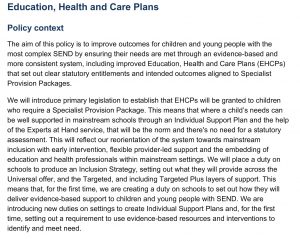
The consultation does not have any questions about limiting the powers of tribunals. After a legal complaint about this, the government suggested feedback could be given in the “any other comments” question at the end. Read more HERE.

The White Paper does not say anything about EOTAS and there are no consultation questions about EOTAS but there are ways round this. CLICK HERE OR SCROLL DOWN FOR TIPS ON RESPONDING TO THE CONSULTATION.

Turning White Paper Into Law

On May 13th 2026 the Kings Speech will announce the government’s planned legislative programme for the coming parliamentary session at the State Opening Of Parliament. A new education bill will be needed for the White Paper.

Existing EHCPs

Some changes could be introduced by September 2029. However, the White Paper says that children who already have EHCPs prior to September 2029 will keep them throughout their existing phase of education (ie until they reach the end of primary, secondary, or post-16)

The government is expecting an increase in EHCP applications before the EHCP threshold is raised. Below is information on applying for an EHC needs assessment which can be done by parents, not just by schools.

Interplay With Children’s Wellbeing Bill

The Children’s Wellbeing and Schools Bill does not stop children with special educational needs and disabilities [SEND] from being home educated. At the same time,the Bill will definitely hit families harder where there is special needs or disability.

SEND Reform Consultation Questions

The Schools White Paper does not say anything about Education Otherwise Than At School [EOTAS], only about time-limited alternative provision to support reintegration to mainstream.

The consultation document also fails to ask questions about some proposals which ARE included in the White Paper such as limiting the power of tribunals.

There are several ways to think about responding to a consultation. A typical approach seems to be to start at the beginning and answer all the questions in order, ending with long impassioned response for the very last question.

An alternative option is to IDENTIFY – before you even begin your answers – ANY RELEVANT QUESTIONS WHERE YOU CAN MAKE YOUR POINTS.

For example, MY focus is on children who are – or who become – UNABLE to attend their local school, so for me the following questions are likely to be somewhere I can include variants of “attending a setting is not always possible “ or “attending a local setting is not always possible” or “how will this work for children who are not in school”

Q1. We want children, young people and their families to be involved in making
better, evidence‐based decisions about SEND, both in their local area and across
the country. How can we make sure children, young people and their families have a genuine
say
in these decisions?
Q2. How can we make sure that high-quality evidence and best practice inform
decisions about SEND? Please share examples.
Q4. How can we ensure that children in the Targeted layer, are best supported?
Q5. How can we ensure that children in the Targeted Plus layer, are best supported?
Q6. How can we ensure that children in the Specialist layer are best supported?
Q7. How do you think early years settings, schools, and college can best support
the mental health and wellbeing of children and young people?
Q8. Do you agree that the refreshed ‘areas of development’ will support educators
to understand and address barriers to learning and participation? Please explain
your answer.
Q11. What should the top three priority areas be for building and sharing evidence
within the National Inclusion Standards?
Q12. What are the most important issues for national training to cover, to help
support children and young people with SEND?
Q15. What would provide assurance for families that an Individual Support Plan
(ISP) is high-quality and contains the essential information?
Q17: How can we best support transition for young people with SEND, so that they
are well supported into post-16 provision and further education, training or
employment?
Q18. How can we make sure that every area can meet the full range of the needs of
children and young people through Inclusion Bases?
Q19. How can we make sure that Inclusion Bases help children and young people
succeed in mainstream settings?
Q20. Through the Experts at Hand offer, we want to ensure that mainstream
settings can get quick specialist support for children and young people.
What arrangements are needed between local area partners (education, health,
social care) to deliver this Experts at Hand offer effectively?
Q21. What needs to be in place so that children and young people with low
incidence, highly complex needs
can always access the right specialist placement?
Q22. How can Specialist Provision Packages be designed to effectively support the
main types of need we currently recognise?
Q23. We propose that EHCPs will guarantee educational provision set out in a
Specialist Provision Package, with day-to-day provision captured in Individual
Support Plans.

What is needed to make these proposals work effectively?
Q25. What would you expect to be considered as part of the needs assessment, for
example evidence and expert or professional input?
Q26. What factors should LAs take into account in proposing to parents and young
people a list of potential settings to name on a plan?
Q27. What information and support do parents need to make a decision about
which setting will be best for their child?
Q28. What do you think is the right maximum length of time for a temporary
placement in Alternative Provision
(AP) schools? Please explain your rationale.
Q29. We have set out our plans to regulate Independent Special Schools (ISS)
sector.
Do you agree that these proposed changes will lead to suitable placements being
available at a fair cost? Please explain why.
Q39. This consultation outlines a series of measures intended to reform the SEND
system. Some of these measures have already been finalised, and this is clearly
indicated within the document.
With this in mind, is there anything further you would like to contribute to help
inform the remaining proposals that are still under consideration?