
The government hopes to change the law on EOTAS [Education Otherwise Than At School] as part of its wider SEND reform plans [Special educational needs and disability]. Feedback can currently be given via a public consultation which is open until September 18th 2026; GOV.UK consultation links are at the foot of this page.
What will happen with EOTAS in future will depend on the child’s age, whether they have an EHCP already, and whether they have EOTAS in place already. This page provides a breakdown of various different circumstances. (Post-16 is also covered in the EOTAS consultation but not included on this page for reasons of space)
The proposals are at a very early stage and a whole new bill has yet to go through parliament. We know it will be called the Education For All Bill but it has not yet been published.
The government hopes “the first cohort of children and young people to transition will be those in at the end of primary, secondary and Post-16 in 2029/30. They will be assessed from September 2029 and will move to the new system in September 2030.” [SEND Reform February 2026 p 73]
- Mainstream with EHCP
- Special School
- EOTAS with EHCP Primary
- EOTAS with EHCP Secondary
- No EHCP
- New Style EOTAS
Mainstream With EHCP
For children with an Education Health and Care Plan [EHCP] on roll in mainstream when the law changes, the proposal is for the EHCP to remain in place until the end of the current phase of education. Note that it will no longer be possible for new–style EOTAS to replace school – as can happen now under section 61 if inappropriate for provision to be made in school – once the law changes.
If the government succeeds in changing SEND law, the local authority [LA] will make an assessment as the child or young person reaches the end of their current phase of education (eg end of primary or end of secondary) to determine whether a Specialist Provision Package [SPP] is necessary for the next phase of education.
If yes, then a new-style EHCP will be developed based on the Package which opens the door to possible new-style EOTAS, see below.
If no, then there will just be an Individual Support Plan developed by the setting where the child or young person is on roll. [SOURCE = SEND Reform February 2026 page 72, see also EOTAS consultation document pages 28-29 ]
Special School
The government has said that “All children and young people who have a special school place in September 2029 will be able to stay in special school until the end of their education, unless they choose to move to a mainstream setting. Their EHCP and support will continue to be reviewed annually” [SOURCE = SEND Reform February 2026 page 73, see also EOTAS consultation document pages 29]
For those on roll at special school, it will not be possible for EOTAS to replace school – as can happen now under section 61 if inappropriate for provision to be made in school – once the law changes.
EOTAS With EHCP Primary
Chapter 2 of the EOTAS consultation document sets out the plan for those with an existing EOTAS arrangement at the point when the law changes. For those in primary, current EOTAS will not continue. Some will be judged eligible for a Specialist Provision Package plus new-style EHCP, while others will be in line for “transition planning” after the current EHCP is ceased, potentially via an alternative provision school.
Page 30 of the EOTAS consultation document says “Children in early years and of primary school age receiving EOTAS arrangements would have their needs assessed at end of the primary phase. Those who are eligible for a specialist provision package will have a new style EHCP drafted and receive support with their arrangements in line with the proposals set out in Chapter 2.
For those who are not eligible for a specialist provision package, we are interested in views on what alternative arrangements might be appropriate, recognising that many will need a more stable transition following previous placement breakdowns in mainstream settings. This could include structured transition planning, and the potential role of schools, or alternative provision in overseeing and supporting these arrangements.”
(NB where it says “without an EHCP” below, it means after their EHCP has been taken away if they are judged not to meet the criteria for a Specialist Provision Package and new-style EHCP.)
Page 30 of the EOTAS consultation document says “Rather than moving children without an EHCP back into a mainstream setting, one proposal is that the child moves onto the roll of an alternative provision school.* The alternative provision school will oversee the education provision and support the child and facilitate a return to a school (alternative provision or mainstream), when this is appropriate and achievable.”
* Alternative provision [AP] schools include pupil referral units which are run by the local authority, plus AP academies and AP free schools which are independent of the local authority but still state funded. This 2026 House of Commons Library Research Briefing on Alternative Education Provision in England [LINK] has more information on numbers in different types of AP.
EOTAS With EHCP Secondary
Page 30 of the EOTAS consultation document says “For those in secondary and post-16 phases at the point reforms are introduced, existing arrangements would continue, i.e. they will keep their existing EHCP and the rights and duties associated with it, with local authorities retaining oversight for the remainder of the child or young person’s education.”
No EHCP
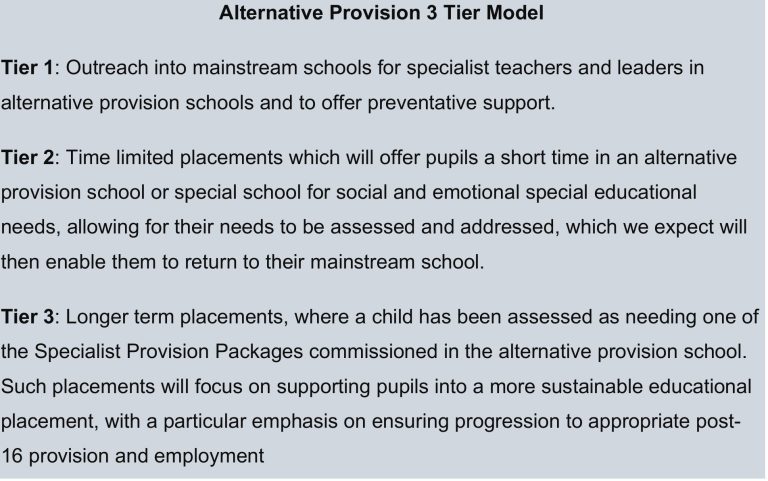
Children and young people who do not have an EHCP at the point when the new law comes into force will need to meet the new criteria for a Specialist Provision Package before they are able to gain access to possible new-style EOTAS. See Appendix 2 Alternative Provision 3 Tier Model below, from page 44 of the EOTAS consultation document.
New Style EOTAS
Future EOTAS will only be possible if the child or young person meets the criteria for a new Specialist Provision Package. More on SPPs below.
The question then arises as to who decides whether EOTAS is even necessary. There is a somewhat misleading visual on page 27 which suggests it would be up to the local authority to decide, after a Specialist Provision Package has been drawn up and a placement has been identified. (A placement will ALWAYS be identified)
However, page 18 of the EOTAS consultation document suggests that having the LA decide is NOT the government’s favoured option.
Page 18 says “Alternatively, we could explore a model in which the local authority does not have a formal role in determining whether some or all of a child or young person’s provision should be delivered otherwise than in a school or further education setting. Instead, responsibility for this decision would sit with the named setting overseeing delivery of the Specialist Provision Package. The setting would determine whether EOTAS arrangements are required to deliver the package effectively and would be responsible for the day-to-day management of those arrangements. Having the school or further education setting act as the sole commissioner would establish a single point of accountability for commissioning and delivery, providing greater clarity for parents and supporting more timely and responsive decisions about a child or young person’s provision.”
This is covered in consultation question 2 which asks “Which approach to commissioning and overseeing EOTAS arrangements do you think would work best?”
There is also a lack of clarity over the contents of future EOTAS provision and how much this might differ from the bespoke EOTAS packages possible under current law. In the EOTAS consultation document this comes under the heading of “Quality assurance and regulation of EOTAS provision” which begins at page 23.
Page 24 says that the government is thinking about “extending national standards to non-school alternative provision settings delivering special educational provision as part of EOTAS arrangements.”
It is not clear whether this means that EOTAS could only be delivered via a setting ie that a child or young person would be expected to attend a setting in order to access their EOTAS provision.
This is potentially covered by consultation question 8 which asks “Do you agree or disagree that non-school alternative provision delivering EOTAS special educational provision to children of compulsory school age should be required to comply with new national regulatory standards?”
Getting An EHCP
Consultation Links
- https://www.gov.uk/government/consultations/send-reform-education-otherwise-than-at-school
- https://consult.education.gov.uk/accountability-and-special-schools/send-reform-education-other-than-at-school
- https://consult.education.gov.uk/accountability-and-special-schools/send-reform-education-other-than-at-school/consultation
- https://www.gov.uk/government/consultations/send-reform-education-otherwise-than-at-school/send-reform-education-otherwise-than-at-school-what-parents-and-carers-of-children-and-young-people-need-to-know
Related Edyourself Pages
- https://edyourself.org/send-reform-changeover-new-system/
- https://edyourself.org/existing-eotas-in-send-reform/
- https://edyourself.org/eotas-specialist-provision-packages/
- https://edyourself.org/eotas-and-alternative-provision-future/
- https://edyourself.org/ehcps-and-eotas-disappearing/
- https://edyourself.org/eotas-consultation-changes-everything/
- https://edyourself.org/eotas-send-consultation-first-impressions/
- https://edyourself.wordpress.com/2026/07/11/email-eotas-families-secondary-age-or-older/
- https://edyourself.org/send-reform-england/
- https://edyourself.org/send-reform-consultation-response/
- https://edyourself.org/eotas/
- https://edyourself.org/eotas-case-law-leaving-section-i-blank/