
The government is currently seeking to change the landscape of education otherwise than at school [EOTAS] It has set out its plans in an EOTAS consultation which is open until September 18th 2026. The EOTAS consultation document claims that system changes designed to transform schools will enable schools to manage everything – including education otherwise than at school.
Current Law Local Authority Responsible
Under current law, the responsibility for education otherwise than at school ultimately rests with the local authority [LA]. There are undoubted drawbacks to the current law but as long as legal responsibility rests with LAs the law must provide independent routes for families to challenge local authority decisions.
Challenging LA Decision
In cases of special educational needs the local authority can block section 61 EOTAS via an EHCP either by refusing to issue an EHCP in the first place or by agreeing to issue but then naming a school on the Plan.
Parents do have a right to appeal all these LA decisions by going to tribunal, although it can take a very long time. SEND tribunals uphold 99% of appeals in favour of the parent/young person bringing the case against the LA, see https://edyourself.org/tribunal-for-ehcp/#stats
Meanwhile, even after obtaining an EHCP with Section I left blank for EOTAS, some families may still find that the local authority insists on handing everything over to an approved tuition agency or favoured alternative provider regardless of whether the provider is actually equipped to deliver the specific provision set out in the EHCP.
Meanwhile, education otherwise than at school WITHOUT AN EHCP is covered by section 19 of the Education Act 1996 which states that “Each local authority in England shall make arrangements for the provision of suitable education at school or otherwise than at school for those children of compulsory school age who, by reason of illness, exclusion from school or otherwise, may not for any period receive suitable education unless such arrangements are made for them.”
In my experience of Ombudsman complaints, many local authorities have a fixed belief that their alternative provision duties are limited to illness and exclusion with a narrow definition of “illness” plus rigid criteria for access to medical needs tuition. (Where LAs do make provision in “otherwise” circumstances, this may be restricted to children without a school place, such as those moving into the area or waiting for a space to open up at special school.)
Parents tend to find that the “otherwise” category is ignored by schools and local authorities and that without a medical professional’s letter stating that it is medically impossible for a child to attend school, the school default is to mark the register unauthorised absence.
In any event, there is no “must-do” deadline for the local authority to secure alternative provision when a child is unable to attend school because of illness; the 2023 “health needs” guidance only says the LA “should” – not must – begin the process after 15 days of absence [LINK] as does the Alternative Provision 2025 guidance [LINK]
The lack of a statutory deadline combined with ignoring the “otherwise” category and demanding a level of medical proof which is impossible for most families to obtain, all give rise to local policies where the vast majority of non-attendance is dealt with at the school level and managed by adjusting the pupil’s timetable and/or by going down the enforcement route with penalties for unauthorised absence.
However, despite the various drawbacks outlined above, current law does provide routes of redress. When parents take formal complaints to the Ombudsman about lack of alternative provision, LAs’ interpretation of section 19 does not stand up to scrutiny, although there is a marked degree of support at the Ombudsman for the “reintegration first” model, in which the section 19 duty is not engaged until much later, as seen below.
“Councils should consider any attempts the school is making to support the child. This might involve sending work home for the child to complete, arranging disability related support, placing the child on a reduced timetable, or providing online education as a short-term measure. If there is a clear, effective, and time-bound plan for reintegration then there may be no immediate role for the council in providing alternative education.” [LINK]
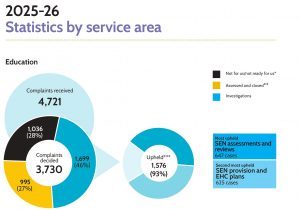
The Ombudsman can also investigate whether the local authority is in breach of its duties under the Children and Families Act 2014. Section 42 says “(2)The local authority must secure the specified special educational provision for the child or young person. Read more here https://edyourself.org/eotas/#s42duty The Ombudsman upholds 93% of SEND complaints [LINK]
Changing Law To Fit Policy
Despite – or perhaps because of all this – we can see in the EOTAS consultation that the government is leading with the idea that there is “confusion” over roles and responsibilities between schools and local authorities. In reality though, the confusion only arises because local authority policies fall short of what the law says.
Instead of addressing the difficulties identified above – such as LAs refusing EHCPs or naming a school on the EHCP which the child has long been unable to attend or delegating EOTAS to an unsuitable provider or limiting alternative provision duties to medical needs and exclusion or claiming that responsibility always lies with schools – the government is proposing to adjust the law to make a better fit with existing LA policies and practice.
Removing Local Authority Responsibility
The EOTAS consultation proposes to fix the law by limiting access to alternative provision when a child does not have an EHCP. All such AP would be arranged and managed by schools and sourced from an approved list of providers. The alternative provision would also be time-limited.
This now becomes very relevant to EOTAS because the wider SEND reforms announced earlier in the year already proposed restricting who is allowed to have an EHCP in future, and reviewing existing EHCPs against the new rules.
In other words, most children and young people who are currently eligible for EOTAS with an EHCP will not meet the criteria in future. Feedback on this point can be given via CONSULTATION QUESTION 1.
For the few who do meet the new criteria, the new-style EHCPs will NOT – as now – set out individual provision specifically required to meet the individual’s needs, but instead will
- be generated from pre-set “specialist provision packages”
- always name a placement – CONSULTATION QUESTION 2 then asks whether it should be the placement which decides whether EOTAS is required
Reframing EHCPs in this way enables the government to say that they are not taking EHCPs away. In reality though, only the name will stay the same; the EHCP itself will be unrecognisable. Furthermore, if all provision decisions are up to the school, the Ombudsman route will be closed since the Ombudsman cannot look at what happens in schools.
The government is saying that families will still be able to go to tribunal but again this will be largely meaningless since there will be no appeal rights over individual special educational needs nor the special educational provision required to meet those needs.
In addition, tribunals will no longer be able to issue directions about placement which means tribunals won’t be able to order EOTAS; this is covered in the EOTAS consultation on pages 22-23 under the heading “Appealing decisions regarding EOTAS arrangements.” Feedback can be given via CONSULTATION QUESTION 7.
To complete the transformation of EOTAS for special needs, the government is also thinking about only allowing the same approved list of providers as for non-SEND alternative provision.
In the EOTAS consultation this comes under the heading “Quality assurance and regulation of EOTAS provision” and is expressed as “extending national standards to non-school alternative provision settings delivering special educational provision as part of EOTAS arrangements” pages 23-25. Feedback can be given via CONSULTATION QUESTIONS 8 AND 9.
Consultation Links
- https://www.gov.uk/government/consultations/send-reform-education-otherwise-than-at-school
- https://consult.education.gov.uk/accountability-and-special-schools/send-reform-education-other-than-at-school
- https://consult.education.gov.uk/accountability-and-special-schools/send-reform-education-other-than-at-school/consultation
- https://www.gov.uk/government/consultations/send-reform-education-otherwise-than-at-school/send-reform-education-otherwise-than-at-school-what-parents-and-carers-of-children-and-young-people-need-to-know
Related Edyourself Pages
- https://edyourself.org/eotas/
- https://edyourself.org/eotas-future-projections/
- https://edyourself.org/eotas-specialist-provision-packages/
- https://edyourself.org/ehcps-and-eotas-disappearing/
- https://edyourself.org/eotas-and-alternative-provision-future/
- https://edyourself.org/eotas-send-consultation-first-impressions/
- https://edyourself.org/eotas-consultation-changes-everything/
- https://edyourself.wordpress.com/2026/07/11/email-eotas-families-secondary-age-or-older/
- https://edyourself.org/send-reform-england/
- https://edyourself.org/send-reform-consultation-response/
- https://edyourself.org/unregistered-ap-voluntary-standards/