
The government plans to change the way SEND [special educational needs and disability] law operates for pre and post-16. It is currently projected to change in 2029/30.
The government has said that when the law changes, children and young people of secondary age or beyond with EOTAS [Education Otherwise Than At School] arrangements already in place can continue with their existing arrangements.
This page examines the plan more closely because on the one hand, the government has said that “For those in secondary and post-16 phases at the point reforms are introduced, existing arrangements would continue, i.e. they will keep their existing EHCP and the rights and duties associated with it, with local authorities retaining oversight for the remainder of the child or young person’s education.”
I wrote about this immediately the EOTAS consultation opened
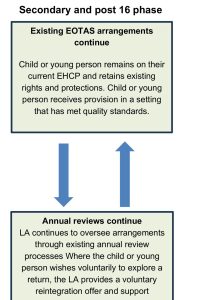
However, I now see that the government has also said “We intend for the same quality assurance arrangements to apply to both new and existing EOTAS provision“. There is even a visual on page 32 which says both things in the same box ie “existing EOTAS arrangements continue” AND “receives provision in a setting that has met quality standards.”
This is of particular interest to me since my work brings me into contact with families where the child or young person’s special educational needs and/or disability mean that they are unable to attend ANY setting.
I have written about the quality assurance proposals here. The government previously said they were for interim alternative provision not EOTAS.
The government may mean that IF a child or young person attends an alternative setting as part of their EOTAS provision, THEN that setting should meet proposed quality assurance standards. I think this is what is meant, and people will presumably have a variety of views on that point.
However, it COULD also indicate an expectation that a setting would become the norm for future EOTAS provision.
This needs to be clarified as not all children and young people can attend a setting; points can be made via the public consultation on the EOTAS proposals which is open until September 18th 2026; GOV.UK consultation links are at the foot of this page.
Existing Rights And Protections
A further point to raise in any EOTAS consultation response concerns “existing rights and protections” in the upper box of the page 32 visual versus the lower box which deals with annual reviews, saying “LA continues to oversee arrangements through existing annual review processes.”
Under current law, it is not unknown for local authorities to use the annual review process as a means of altering or ceasing the current arrangements so presumably this would remain a possibility for Secondary and Post-16 Existing EOTAS after the law changed?
However, current law also provides a right of appeal to tribunal over decisions made at the annual review for example regarding the contents of the EHCP – including placement – or regarding a decision to cease the EHCP (and in the case of proposed ceasing, the LA must maintain the EHCP as is, until after the conclusion of any tribunal appeal)
Something to confirm in the EOTAS consultation would be that “retains existing rights and protections” does include existing tribunal rights as above, particularly as tribunal rights are being slashed in the rest of the SEND reform plans. [LINK]
Background
After falling out of mainstream, a special school placement may have been tried and failed, or perhaps the child has left the school system if special school or EOTAS could not be agreed at that time. Alternatively the child may never have been on roll at any school and always been home educated; this last scenario is the least likely to have an EHCP.
Through the Children and Families Act 2014, it is currently possible – although very difficult – to access highly personalised EOTAS provision with a personal budget via an Education Health and Care Plan [EHCP].
Some families may have this in place already – although in my experience it is usually only possible by going to tribunal – while others are still going through the process, or debating whether to do so, given that EHCPs can go up to age 25.
EOTAS Consultation Extracts
Chapter 1 of the EOTAS consultation document at page 8 says “For those children and young people of secondary school age or older than 16 with an existing EOTAS arrangement in 2029/30: we will seek views on protecting that arrangement until they leave the education system.”
Page 20 says “Transition arrangements for children and young who are already receiving EOTAS provision in 2029/30 are set out in Chapter 2, where we propose that all children and young people in secondary and post 16 phases retain their existing arrangements.”
Page 24 says We are interested in views on: extending national standards to non-school alternative provision settings delivering special educational provision as part of EOTAS arrangements. These standards could become mandated, though we are keen to understand how this could be applied without creating unnecessary burdens; whether local authorities should quality assure such provision, with commissioners only allowed to use provision on approved lists; clarifying the role of schools or further education settings responsible for specialist provision packages in ensuring placements are appropriate to need, coherent and focused on outcomes
Chapter 2 of the EOTAS consultation document then starts at page 28.
Page 29 says “we are interested in whether different approaches may be needed depending on the age and circumstances of the child or young person. For children and young people in secondary and post-16 phases, who may have spent many years in the same arrangements, often after a series of placement breakdowns, stability may be the priority where EOTAS provision is established and working well.”
Page 30 says “For those in secondary and post-16 phases at the point reforms are introduced, existing arrangements would continue, i.e. they will keep their existing EHCP and the rights and duties associated with it, with local authorities retaining oversight for the remainder of the child or young person’s education.”
Page 32 says “As set out in Chapter 1, we are seeking views on how quality assurance for provision delivered outside a school or further education setting could be strengthened. We intend for the same quality assurance arrangements to apply to both new and existing EOTAS provision. To avoid duplication, we are not repeating those questions here. Refer to Chapter 1 (Quality assurance and regulation of EOTAS provision) and respond to those questions in relation to new arrangements, existing arrangements or both.“
Consultation Links
- https://www.gov.uk/government/consultations/send-reform-education-otherwise-than-at-school
- https://consult.education.gov.uk/accountability-and-special-schools/send-reform-education-other-than-at-school
- https://consult.education.gov.uk/accountability-and-special-schools/send-reform-education-other-than-at-school/consultation
- https://www.gov.uk/government/consultations/send-reform-education-otherwise-than-at-school/send-reform-education-otherwise-than-at-school-what-parents-and-carers-of-children-and-young-people-need-to-know
Related Edyourself Pages
- https://edyourself.org/eotas/
- https://edyourself.org/eotas-case-law-leaving-section-i-blank/
- https://edyourself.wordpress.com/2026/09/11/eotas-consultation-questions-2026/
- https://edyourself.org/send-reform-changeover-new-system/
- https://edyourself.org/eotas-specialist-provision-packages/
- https://edyourself.org/eotas-and-alternative-provision-future/
- https://edyourself.org/ehcps-and-eotas-disappearing/
- https://edyourself.org/eotas-consultation-changes-everything/
- https://edyourself.org/eotas-send-consultation-first-impressions/
- https://edyourself.wordpress.com/2026/07/11/email-eotas-families-secondary-age-or-older/
- https://edyourself.org/send-reform-england/
- https://edyourself.org/send-reform-consultation-response/
- https://edyourself.org/unregistered-ap-voluntary-standards/