
The Children’s Wellbeing and Schools Act 2026 says that in future SOME PARENTS WILL NEED PERMISSION from the local authority to withdraw their child from school for home education, with the local authority deciding whether school or home education is in the child’s best interests. This will apply to England and to Wales.
The new law has been published but not been “commenced” yet. England and Wales must each make all the necessary secondary legislation (regulations and guidance) before the new law can come into force and this takes time.
THERE IS NO DEFINITE DATE FOR WHEN THIS WILL BECOME LAW, ALL THE GOVERNMENT IS PREPARED TO SAY IS “BY THE END OF THIS PARLIAMENT” READ MORE HERE https://edyourself.wordpress.com/2026/05/29/implementation-date-possibly-2029/
Who Will Need Permission
In future, the children who will need permission are special school pupils. In addition, children attending ANY TYPE OF SCHOOL will need permission if there is an ongoing child protection enquiry or Child Protection Plan, or if there has been a Child Protection Plan in the past 5 years.
The future law on deregistering can be found in section 37 of the Children’s Wellbeing and Schools Act [LINK] under the heading “Withdrawal of children from school: local authority involvement.” Special schools come under “Condition A” while child protection enquiries and plans come under “Condition B”. Scroll down to see exactly what the Act says.
Local Authority To Decide Child’s Best Interests
Section 37 of the Wellbeing Act says the LA “must refuse consent if the local authority considers— “(i) that it would be in the child’s best interests to receive education by regular attendance at school, or (ii) that no suitable arrangements have been made for the education of the child otherwise than at school.
If consent is refused, the parent may not make another request within 6 months.
Child Protection Enquiry or Plan
Child protection legislation can be found in section 47 of the Children Act 1989 [LINK] which has the heading “Local authority’s duty to investigate.” On receiving a safeguarding referral the local authority will decide whether it has “reasonable cause to suspect that the child is suffering, or is likely to suffer, significant harm.”
IF THERE IS A HISTORY OF NON-ATTENDANCE THEN THE SCHOOL – OR THE LOCAL AUTHORITY – COULD MAKE A SAFEGUARDING REFERRAL.
A safeguarding referral does not necessarily lead to a section 47 enquiry and a section 47 enquiry does not necessarily lead to a Child Protection Plan under s 47(8) since CP Plans are for children at risk of significant harm.
However, it is relevant for home educators to be aware that persistent absence from school may lead to a safeguarding referral on the grounds of “educational neglect” and/or because of concerns that the child is “not being seen by professionals”.
THIS MAY MEAN THAT A CHILD WHO IS UNABLE TO ATTEND SCHOOL BECAUSE OF UNMET NEEDS AND/OR ANXIETY COULD FIND THEMSELVES IN THE CHILD PROTECTION PROCESS WHICH MIGHT THEN PREVENT THEM FROM BEING DEREGISTERED.
Statutory guidance on Working Together to Safeguard Children (last updated March 2026 – LINK) contains flowcharts setting out the process and timescales for making safeguarding decisions.
Elective home education is mentioned several times in Working Together 2026. Parents should be able to find their local area threshold document to check when a child might be referred for assessment.
It should be noted that Working Together is due to be revised in 2027 as part of the “children’s social care reset” [LINK] set out in Part I of the Children’s Wellbeing and Schools Act 2026.
Special School Deregistration Current Law
Under current law, a special school cannot remove a pupil’s name from the school roll without consent of the local authority but parents do not have to prove that home education is better than school or that school has failed, and – crucially – the “child’s best interests” test is not part of current law. Click on the link below for more on what the law says now.
What Was Said In Parliament
This section “does not mean that these eligible families will not be able to home-educate their children. We are simply requiring the local authority to take a closer look in those circumstances. It may, in any of those three [subsequently four, when CP Plan last 5 years was added at late stage in parliamentary process] categories, be wholly appropriate for those children to be educated at home, but it is also right, given the specific circumstances, that the local authority that has responsibility—or where those children live—looks at that case and gives consent for home education in those narrow categories of cases.” Baroness Smith of Malvern, House of Lords, July 3rd 2025 [LINK]
What The Act Says
It can be seen that the Act does NOT say “all children with EHCP” (or IDP for Wales) https://www.legislation.gov.uk/ukpga/2026/21/section/37/enacted
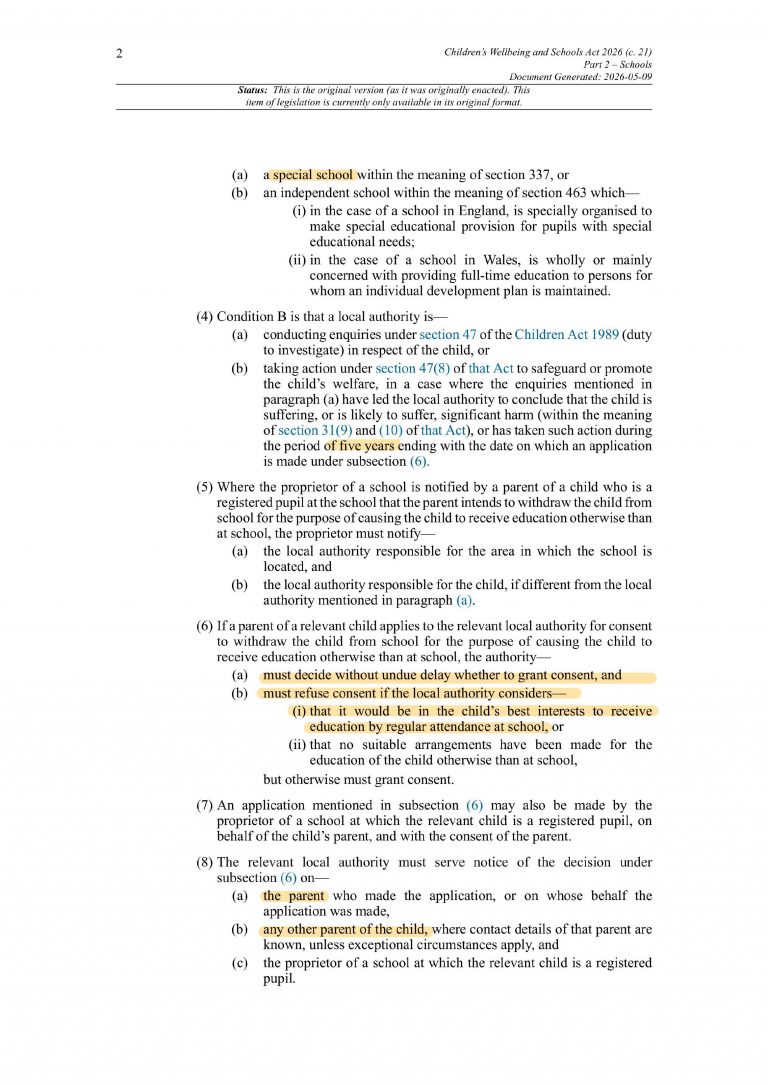
How Will Local Authorities Decide Best Interests
So far all we have is the Act of Parliament which provides for the local authority to determine a child’s best interests on a case by case basis but no further information as to how the local authority might reach a decision. Operational details are still to be set out in regulations and statutory guidance. The government will publish drafts of this secondary legislation as part of a public consultation.
Upcoming Judicial Review
There is a planned legal challenge to local authorities’ being given power to decide the “child’s best interests” meaning that some children could be prevented from coming out of school (see https://edyourself.org/deregistration-future-law/) or could be served with an Attendance Order directing them to be registered with a school.
The crowdfunder says “We seek to bring a legal challenge to test whether these provisions are compatible with the Human Rights Act 1998, particularly the right to family life and protection from discrimination”
I am making donations whenever I am able because I believe we need to be very careful about who decides a “child’s best interests” and who decides “which children may be better served by being in school” and I think this whole area must be looked at much more closely.
https://www.crowdjustice.com/case/challenge-the-risk-of-reducing